Dishwasher Not Heating Water: Causes, Checks and Repair Costs
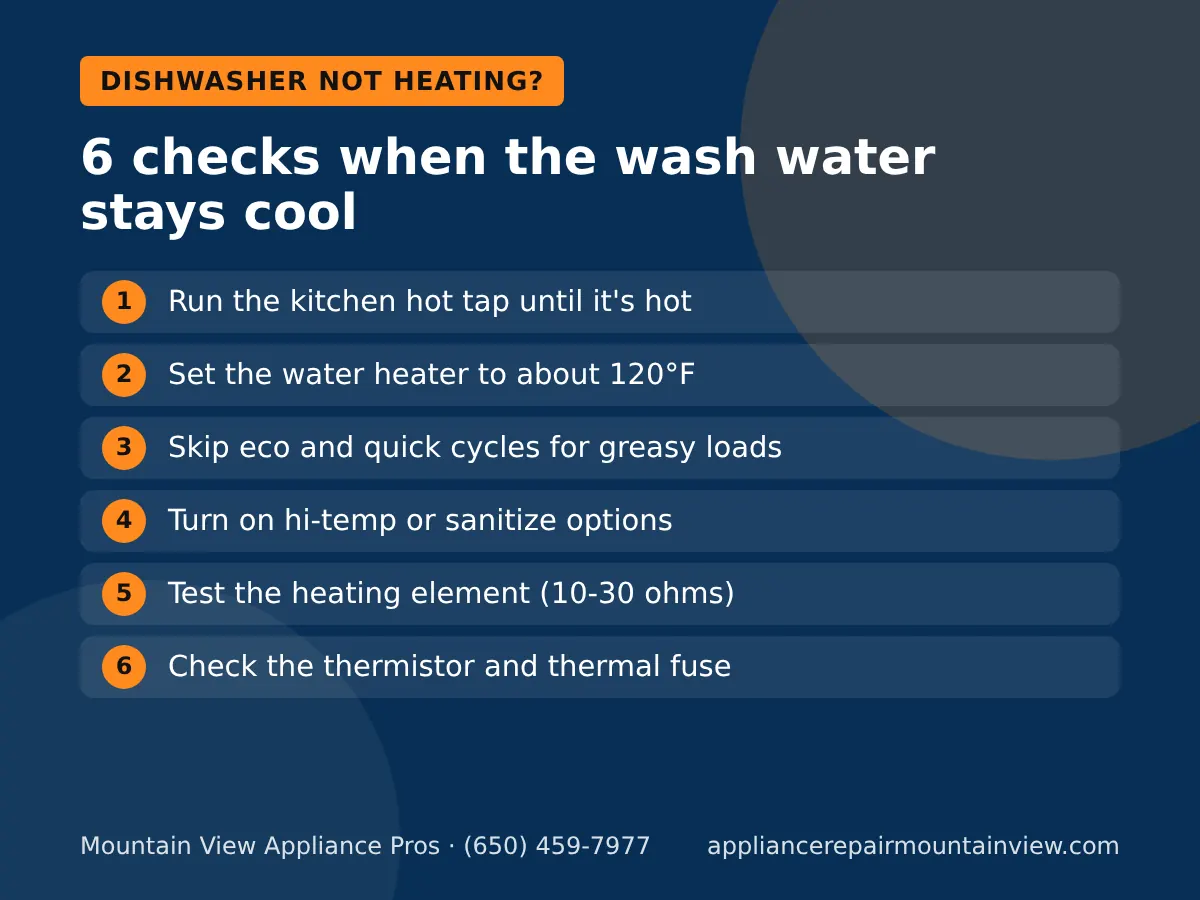
Wash water that never gets hot leaves grease, film and germs behind. Here is how to tell whether the problem is your hot water supply or the dishwasher itself.
Read the guideYou open the washer and the detergent is still sitting in the drawer, or the fabric softener cup is full after the rinse. Your clothes come out dull, stiff or smelling flat. Most of the time the cause is simple: a clogged drawer, low water flow or the wrong product. Sometimes it is a valve or switch. This guide shows you how to tell which.
Call Now – (650) 459-7977
A washer stops dispensing detergent when water can't flush the drawer properly. The usual causes are a clogged drawer or siphon cap, low water flow from the faucets or inlet screens, caked powder or too much product, and less often a failed inlet valve, diverter or dispenser switch. Most homeowners can fix the first three in under 30 minutes.
Here is how the drawer works. During the wash, the washer opens a water valve that sprays into the detergent compartment. That water carries the soap down into the tub. Later, during the final rinse, water flows into the softener cup and pulls it out through a small siphon tube. If the spray is weak, aimed at the wrong cup, or blocked, the product stays put.
Front-load washers and newer high-efficiency top-loaders use far less water than older machines. So a small clog or a little low pressure is enough to leave a mess behind.
Most dispenser problems come down to buildup, water supply or the wrong product. Work through the list in order. The first five you can check yourself. The last three involve parts that are tested with a meter, and in a tight hall closet that is often easier for a technician.
| Cause | What you see | DIY or pro |
|---|---|---|
| 1. Clogged drawer or cavity | Slimy or crusty buildup, water pools in the drawer | DIY |
| 2. Missing or blocked siphon cap | Softener left in its cup after every load | DIY |
| 3. Low water flow | Detergent turns to paste, slow fill | DIY |
| 4. Caked powder or too much product | Hard lumps in the main wash cup | DIY |
| 5. Wrong compartment or setting | Pre-wash cup full, main wash cup empty | DIY |
| 6. Failed inlet valve coil | One cup never gets water, or no water at all | Pro |
| 7. Diverter or dispenser motor | Water goes to the wrong cup every time | Pro |
| 8. Control board fault | Error code, valve never opens for that step | Pro |
Pull the drawer all the way out, take off the siphon caps, soak the parts in warm water for 15 to 20 minutes, then scrub them with an old toothbrush. Clean the cavity the drawer slides into with a damp cloth and a flashlight. Buildup on the ceiling of that cavity is a common hidden clog.
Hard water is common across much of the Bay Area. It leaves white scale that narrows the spray holes over time, so cleaning the drawer every month or two prevents a lot of trouble.
Make sure both faucets behind the washer are open all the way, the hoses are not kinked or crushed against the wall, and the small mesh screens where the hoses meet the washer are clean. Weak flow is one of the top reasons detergent turns to paste instead of washing into the tub.
If the washer is barely filling at all, the problem is bigger than the drawer. Our washer not filling with water guide covers that one step by step.
High-efficiency washers need HE detergent in small amounts, usually one to two tablespoons of liquid for a normal load. Too much soap or thick softener poured past the MAX line won't flush out. Powder can cake in humid laundry rooms. Pods and tablets go in the drum, never in the drawer.
If the drawer and supply are clean but one compartment never gets water, a part is likely to blame. Many washers use a multi-coil inlet valve, and each coil feeds a different cup. Others use a small diverter or dispenser motor to aim the water. A failed coil, diverter or board signal leaves that cup full every time.
Signs it is a part, not a clog:
These parts are tested with a multimeter and are often behind the top panel. Unplug the washer before removing any panel. When it is time for washing machine repair in Mountain View, our technicians work on Samsung, LG, Whirlpool, Maytag, GE, Bosch and Miele washers across ZIP codes 94040, 94041 and 94043. If your machine shows a code, our LG washer error code guide explains many of them.
Most washer dispenser repairs in Mountain View cost about $150 to $400 with parts and labor. Clearing a deep clog or replacing a dispenser drawer is near the low end. An inlet valve or diverter motor sits in the middle. A control board is at the top of that range. A diagnostic visit runs about $95 to $150.
| Repair | Approx. cost in Mountain View |
|---|---|
| Diagnostic visit | $95 – $150 |
| Dispenser drawer or housing replaced | Low end of $150 – $400 |
| Water inlet valve | Middle of $150 – $400 |
| Diverter or dispenser motor | Middle of $150 – $400 |
| Control board | High end of $150 – $400 |
A good rule: if the washer is under 8 to 10 years old and works well otherwise, a dispenser repair is almost always worth it. Leftover detergent also feeds slime and odor, so if your front-loader smells too, see our front-load washer smell tips.
Kitchen trouble too? If your oven is not heating up all the way, our guide on oven not heating up all the way walks through the bake element, sensor and door seal. And if the electric oven not working but stove top is still fine, start with the checks in that post.
The most common causes are a clogged dispenser drawer or siphon cap, low water pressure from half-closed faucets or dirty inlet screens, and caked powder detergent. If the drawer is clean and water flows into it but never reaches one compartment, the inlet valve or diverter that feeds that compartment may have failed.
Softener is flushed in during the final rinse. If it stays behind, the siphon cap may be missing or clogged, the softener is too thick or overfilled past the MAX line, or the rinse fill is too weak. Thin thick softener with a little water and clean the siphon cap first.
Pull the drawer out, pressing the release tab if it has one. Remove the siphon caps, soak everything in warm water for 15 to 20 minutes, scrub with an old toothbrush, and clean the drawer cavity where mold and gunk build up. Let it dry before putting it back.
Yes. The dispenser relies on a strong spray of water to flush detergent out. Half-closed faucets, kinked hoses and clogged inlet screens all lower the flow, so detergent is only partly rinsed in and turns into paste. Fix the water supply before replacing any parts.
If it needs a part, most dispenser repairs cost about $150 to $400 with parts and labor in Mountain View. A clogged dispenser or inlet screen is near the low end. An inlet valve or dispenser motor is in the middle. A control board is at the top. A diagnostic visit runs about $95 to $150.
Tell us what your appliance is doing. We will quote the visit on the phone and book the first open slot, often the same day.
Wash water that never gets hot leaves grease, film and germs behind. Here is how to tell whether the problem is your hot water supply or the dishwasher itself.
Read the guide4C, 5C, UE, dC, LE, OE and more: what each Samsung washer code means, the quick checks you can do first, and when the part behind it needs a repair.
Read the guideYou cleaned the filter and the sump looks clear, but water still sits in the tub. Seven hidden causes, from the air gap to the check valve and pump.
Read the guideCall now to talk to a real person, any time of day or night.
(650) 459-7977 Call Now – (650) 459-7977One call covers every major appliance in your home. Pick a service for signs, costs, and how the repair works.
Fridge warm, leaking, or noisy? We fix cooling, defrost, and sealed system problems.
See refrigerator repair →Washer won't drain, spin, or fill? We repair top-load and front-load machines.
See washer repair →No heat or no tumble? We fix gas and electric dryers and clear vent problems.
See dryer repair →Dirty dishes or standing water? We repair pumps, valves, and control boards.
See dishwasher repair →Oven not heating or heating unevenly? We repair wall ovens and ranges.
See oven repair →Burner won't light or element won't heat? We fix gas, electric, and induction.
See stove & cooktop repair →No ice, slow ice, or leaks? We repair built-in and freezer ice makers.
See ice maker repair →Not heating or dead display? We repair over-the-range and built-in units.
See microwave repair →