Washer Not Dispensing Detergent or Fabric Softener: Causes and Fixes
Powder caked in the drawer, softener left behind, or the whole cup still full? Here is why washers stop pulling detergent and what to check before you call.
Read the guideYou open the dishwasher at the end of a cycle and the dishes feel cool. Glasses are filmy, plates feel greasy and the soap pod may not have fully dissolved. Hot water does most of the cleaning, so when it goes missing, results drop fast. The good news: about half the time the fix is in your kitchen, not inside the dishwasher.
Call Now – (650) 459-7977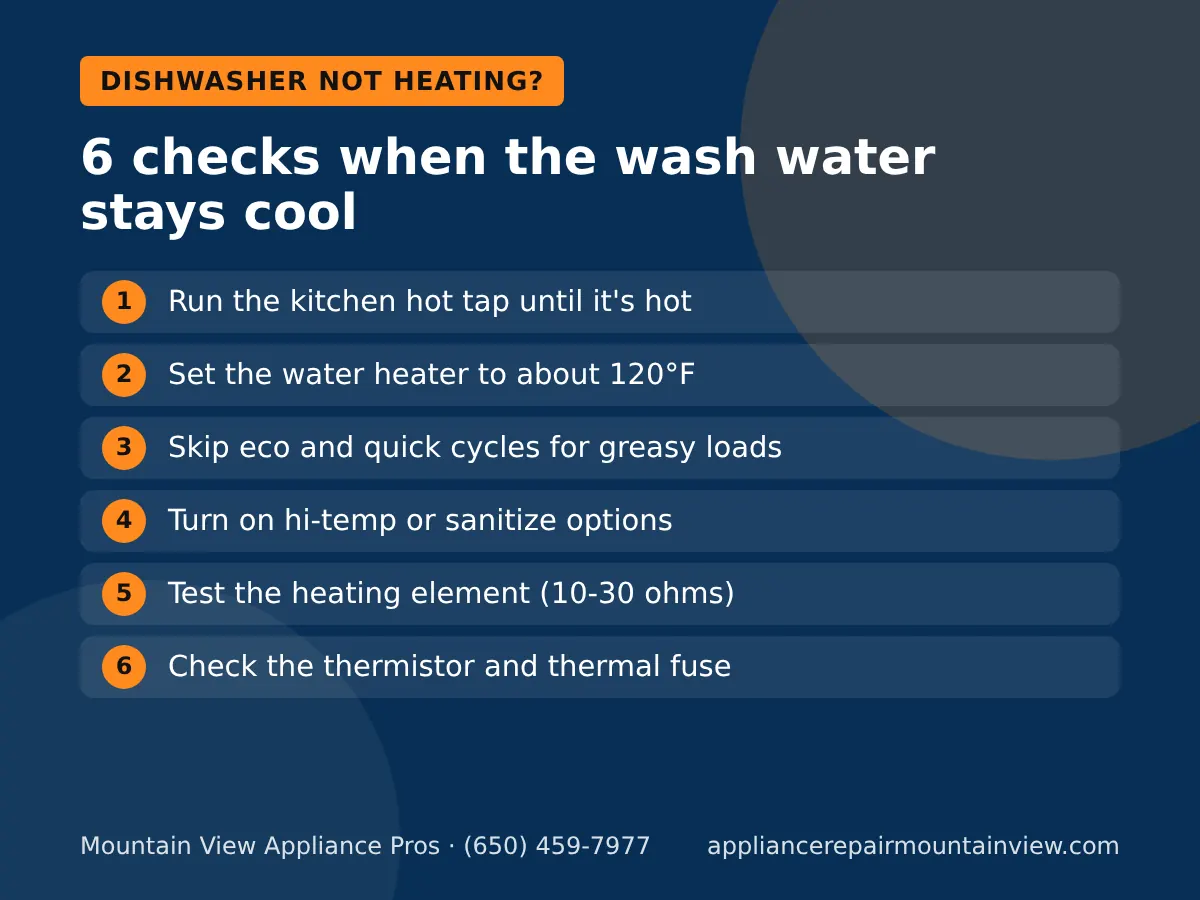
A dishwasher that is not heating water usually has one of two problems. Either cool water is coming in from the house, or the dishwasher's own heater is not working. The most common causes are a long cold run from the water heater, a low water heater setting, a burned-out heating element, a faulty thermistor or thermostat, and less often the control board.
Most dishwashers are hooked to the hot water line under the sink. They then heat that water further during the wash, usually to somewhere between 120 and 150°F. If the incoming water starts cold, the heater has to work much harder, and many models will not wait long enough to catch up.
So the first job is to figure out which side the problem is on: the house or the machine.
Work through these causes in order. The first three involve your plumbing and settings, so you can check them yourself in a few minutes. The last four involve parts inside the dishwasher that are tested with a multimeter. If the first checks don't help, that is usually the point to book a repair.
| Cause | What you notice | DIY or pro |
|---|---|---|
| 1. Cold water in the line | Kitchen tap takes a minute or more to get hot | DIY |
| 2. Water heater set too low | All hot water in the house feels only warm | DIY |
| 3. Wrong cycle or eco setting | Quick or eco cycles run cooler on purpose | DIY |
| 4. Failed heating element | No heat at all, dishes wet and cold | Pro |
| 5. Bad thermistor or thermostat | Cycle runs very long or heats unevenly | Pro |
| 6. Tripped high-limit or thermal fuse | Heater stops working after it overheated once | Pro |
| 7. Control board or relay | Error code, heater never turns on | Pro |
Turn on the kitchen faucet's hot side and time how long it takes to get hot. If it takes more than 30 seconds, the dishwasher fills with mostly cool water. Run the tap until it is hot before you start a cycle. Then check that the water heater is set to about 120°F, the safe setting most makers recommend.
In many Mountain View homes, from 1950s Eichlers in Monta Loma to newer townhomes near San Antonio, the water heater sits in the garage or a side closet. That can mean a long run to the kitchen. A recirculating pump or point-of-use heater can help if cold water is a daily problem.
If every tap in the house runs lukewarm, the water heater itself is the issue. Want to go deeper on tank settings, flushing and repair-or-replace choices? A Southern California team that works only on tanks and tankless units, Mission Viejo water heater service, covers those topics on its site.
Eco, quick, light and glass cycles use lower temperatures on purpose to save energy. If you mostly run those, dishes may never get truly hot. Choose normal or heavy for greasy loads, and turn on options such as hi-temp wash, sanitize or heated dry when your model has them.
Hard water is common in the Bay Area, and cooler washes make film and spots worse. If glasses come out cloudy, use rinse aid and a hotter cycle before you assume a part has failed.
The heating element is the metal loop at the bottom of the tub on most dishwashers. If it never gets warm, dishes stay wet and cold, and the cycle may run very long. With the power off, a technician tests it with a multimeter. A good element shows a low resistance reading, usually around 10 to 30 ohms. No reading means it is open and needs replacing.
Other signs:
Some newer Bosch, Thermador and Miele models hide the heater inside the circulation pump. In those, the whole pump assembly is replaced, which costs more. If drying is your only complaint, our dishwasher not drying dishes guide covers vents, rinse aid and plastic-heavy loads.
The thermistor or thermostat tells the control board how hot the water is. If it reads wrong, the board may shut off the heat too early or wait forever. A high-limit thermostat or thermal fuse cuts power if the tub overheats, and once it trips, the heater may stop for good. All three are tested with a meter.
These sensors usually sit under the tub, near the pump. Reaching them means pulling the dishwasher out from the cabinet, so unplug it at the outlet or breaker first, and shut off the water valve under the sink. If a fuse has blown, ask why. A shorted element or a stuck relay on the board can blow a new fuse right away.
Is the oven giving you trouble too? If your electric oven not working but stove top is still fine, that post walks through the bake element, the igniter and the fuse that often cause it.
Most dishwasher heating repairs in Mountain View cost about $150 to $400 with parts and labor. A thermistor, thermostat or thermal fuse is near the low end. A heating element sits in the middle. A heater pump or control board is at the top of that range. A diagnostic visit usually runs $95 to $150.
| Repair | Approx. cost in Mountain View |
|---|---|
| Diagnostic visit | $95 – $150 |
| Thermistor, thermostat or thermal fuse | Low end of $150 – $400 |
| Heating element | Middle of $150 – $400 |
| Heater pump (some European models) | High end of $150 – $400 |
| Control board | High end of $150 – $400 |
If the dishwasher is under 8 to 10 years old and otherwise cleans well, fixing the heat is almost always worth it. When you need dishwasher repair in Mountain View, our technicians work on Bosch, KitchenAid, Whirlpool, GE, Samsung, LG and Miele models, from Old Mountain View and Cuesta Park to Waverly Park and the North Bayshore area. Still seeing grit and food on the plates? See why a dishwasher is not cleaning dishes well.
Start a normal cycle, wait about 15 to 20 minutes, then carefully open the door and check the water in the bottom with a kitchen thermometer. Wash water should be around 120 to 150 degrees F depending on the cycle. If it is barely warm, the dishwasher is not heating.
Cool dishes usually mean the water never got hot. The most common causes are a long cold run from the water heater, a water heater set too low, a failed heating element, or a bad thermistor. Some newer quiet models also skip heated dry unless you turn it on.
Yes. Run the kitchen tap on hot until the water feels hot, then start the dishwasher. In many Mountain View homes the water heater is in the garage, and the first gallon in the line is cold. Running the tap first can make a big difference.
Some handy owners can, but it means unplugging the unit, turning off the water, pulling the dishwasher out and working under the tub. You also need a multimeter to confirm the element is bad first. If you are not comfortable with wiring, have a technician do it.
Most heating repairs cost about $150 to $400 with parts and labor in Mountain View. A thermistor or thermostat is at the lower end, a heating element is in the middle, and a control board is near the top. A diagnostic visit is usually $95 to $150.
Tell us what your appliance is doing. We will quote the visit on the phone and book the first open slot, often the same day.
Powder caked in the drawer, softener left behind, or the whole cup still full? Here is why washers stop pulling detergent and what to check before you call.
Read the guide4C, 5C, UE, dC, LE, OE and more: what each Samsung washer code means, the quick checks you can do first, and when the part behind it needs a repair.
Read the guideYou cleaned the filter and the sump looks clear, but water still sits in the tub. Seven hidden causes, from the air gap to the check valve and pump.
Read the guideCall now to talk to a real person, any time of day or night.
(650) 459-7977 Call Now – (650) 459-7977One call covers every major appliance in your home. Pick a service for signs, costs, and how the repair works.
Fridge warm, leaking, or noisy? We fix cooling, defrost, and sealed system problems.
See refrigerator repair →Washer won't drain, spin, or fill? We repair top-load and front-load machines.
See washer repair →No heat or no tumble? We fix gas and electric dryers and clear vent problems.
See dryer repair →Dirty dishes or standing water? We repair pumps, valves, and control boards.
See dishwasher repair →Oven not heating or heating unevenly? We repair wall ovens and ranges.
See oven repair →Burner won't light or element won't heat? We fix gas, electric, and induction.
See stove & cooktop repair →No ice, slow ice, or leaks? We repair built-in and freezer ice makers.
See ice maker repair →Not heating or dead display? We repair over-the-range and built-in units.
See microwave repair →