Dishwasher Not Heating Water: Causes, Checks and Repair Costs
Wash water that never gets hot leaves grease, film and germs behind. Here is how to tell whether the problem is your hot water supply or the dishwasher itself.
Read the guideYou turn on the oven, the display looks normal, but nothing heats. Meanwhile the burners on top work fine. That split is good news. It tells you the range has power or gas, so the fault is in a part that only the oven uses, and those parts are usually simple to test.
Call Now – (650) 459-7977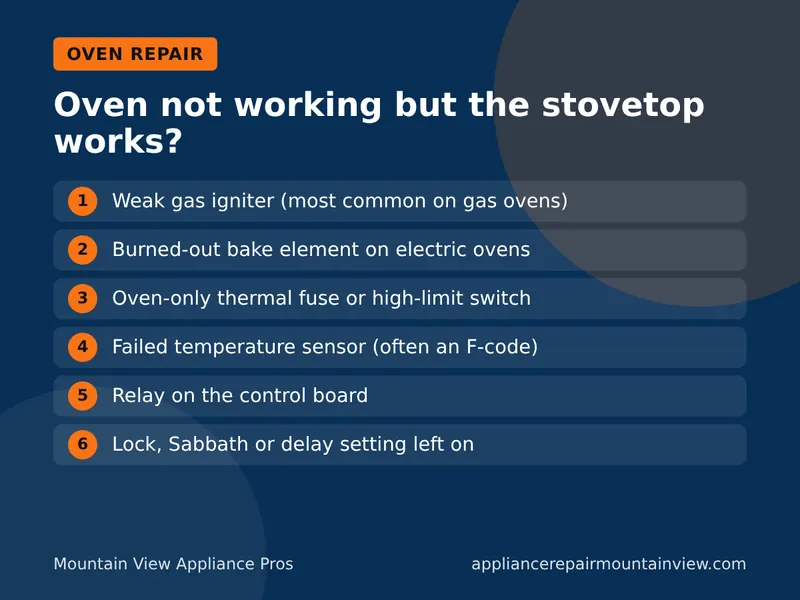
The burners and the oven share power and gas, but they use different parts to make heat. When the top works and the oven does not, the supply is fine. The fault is in an oven-only part: the gas igniter or safety valve, the electric bake element, an oven fuse or high-limit switch, the temperature sensor or a relay on the control board.
If the checks below do not fix it, our oven repair Mountain View CA technicians test igniters, elements, sensors and boards on GE, Whirlpool, KitchenAid, Frigidaire, Samsung, LG, Bosch, Thermador and Wolf ranges, often in one visit.
Start here, because the likely part changes with the fuel. A gas range has knobs that click and blue flames on top. Its oven lights with a glowing igniter under the floor panel. An electric range has coils or a glass top, and its oven heats with a metal element on the bottom. Dual-fuel ranges pair gas burners with an electric oven.
| What you see | Gas oven: likely cause | Electric oven: likely cause |
|---|---|---|
| Display normal, no heat at all | Igniter or safety valve | Bake element, oven fuse or relay |
| Broil works, bake does not | Bake igniter | Bake element |
| Bake works, broil does not | Broil igniter | Broil element |
| Heats a little, never reaches temperature | Weak igniter | Element with a hidden break, or sensor |
| Error code, then shuts off | Sensor or board | Sensor, door lock or board |
This is the number one cause on gas ovens. The igniter has to get hot enough to open the safety valve. As it ages, it still glows but draws too little current, so the valve stays shut and the burner never lights. The top burners use spark igniters instead, so they keep working.
On electric ovens, look at the bottom element. A blister, a split or a spot that looked like a spark during the last bake means it has failed. Hidden elements under the oven floor can fail with no visible sign.
Many ranges have a thermal fuse or limit switch for the oven only. It cuts power if the oven runs too hot, which can happen during a self-clean cycle. The burners keep working because they are on a different circuit.
The thin probe on the back wall tells the board how hot the oven is. If it reads wrong, the board may never turn on the heat, or shut it off early. Many ovens show an F-code when the sensor fails.
The board turns the bake and broil circuits on with small relays. A relay can burn out after years of heavy use, so the oven gets no power even though the display looks fine.
Sabbath mode, a control lock, a delayed start or a demo mode can stop the oven from heating. Check the display for a lock icon or a clock time set for later.
Burners work but the oven is cold? Call now for oven repair in Mountain View.
Stop and call if you smell gas that does not clear, see sparks or smell burning wires. Do not remove the oven floor or back panel with the power or gas still on. Read our guide on why wont my oven turn on if the display is dark too, because that points to power, not an oven part.
A technician checks what the control board is asking for, then follows the power path to the heat source. On gas ovens, they measure the current through the igniter, because a weak igniter can glow and still fail. On electric ovens, they test the element, fuse and relay with a meter. Most of these parts are in stock, so many repairs finish the same day.
Most oven repairs in Mountain View cost about $150 to $500 with parts and labor. An igniter, bake element or sensor usually lands in the lower half of that range. A control board sits at the top. The diagnostic visit is usually about $95 to $150 and is often applied to the repair. You get the price before any work starts.
| Appliance | Typical repair (approx.) |
|---|---|
| Oven | $150 – $500 |
| Stove or cooktop | $150 – $450 |
Since the burners still work, the range is usually worth saving. Ranges often last 13 to 15 years. For a pro-style range from Wolf, Thermador or Viking, common in Cuesta Park, Waverly Park and the newer homes off Middlefield Road, a repair is almost always the better value. Our team handles appliance repair in Mountain View across 94040, 94041 and 94043.
Something else acting up? These guides may help: why is my oven not turning on, dryer keeps shutting off after a few minutes and a dishwasher that will not drain.
The burners and the oven use separate parts. On a gas range, the oven has its own igniter and safety valve. On an electric range, it has its own bake element, broil element and fuse. When only the oven fails, one of those oven-only parts, the temperature sensor or the control board is usually the cause.
Usually, yes. Most oven repairs in Mountain View cost about $150 to $500 with parts and labor, and an igniter or bake element sits in the lower part of that range. That is far less than a new range.
Yes, on some electric ranges. A thermal fuse or a high-limit switch protects the oven cavity. If it trips, the oven stops heating while the surface elements keep working.
On a gas oven, look through the window at the bottom burner. A good igniter glows bright orange and the burner lights within about 90 seconds. A weak igniter glows but the burner never lights, and you may smell a little gas before the oven shuts the valve.
The control board is calling for heat, but the heat source is not answering. That points to a failed igniter or bake element, a broken wire, a blown oven fuse or a bad relay on the board.
Tell us what your appliance is doing. We will quote the visit on the phone and book the first open slot, often the same day.
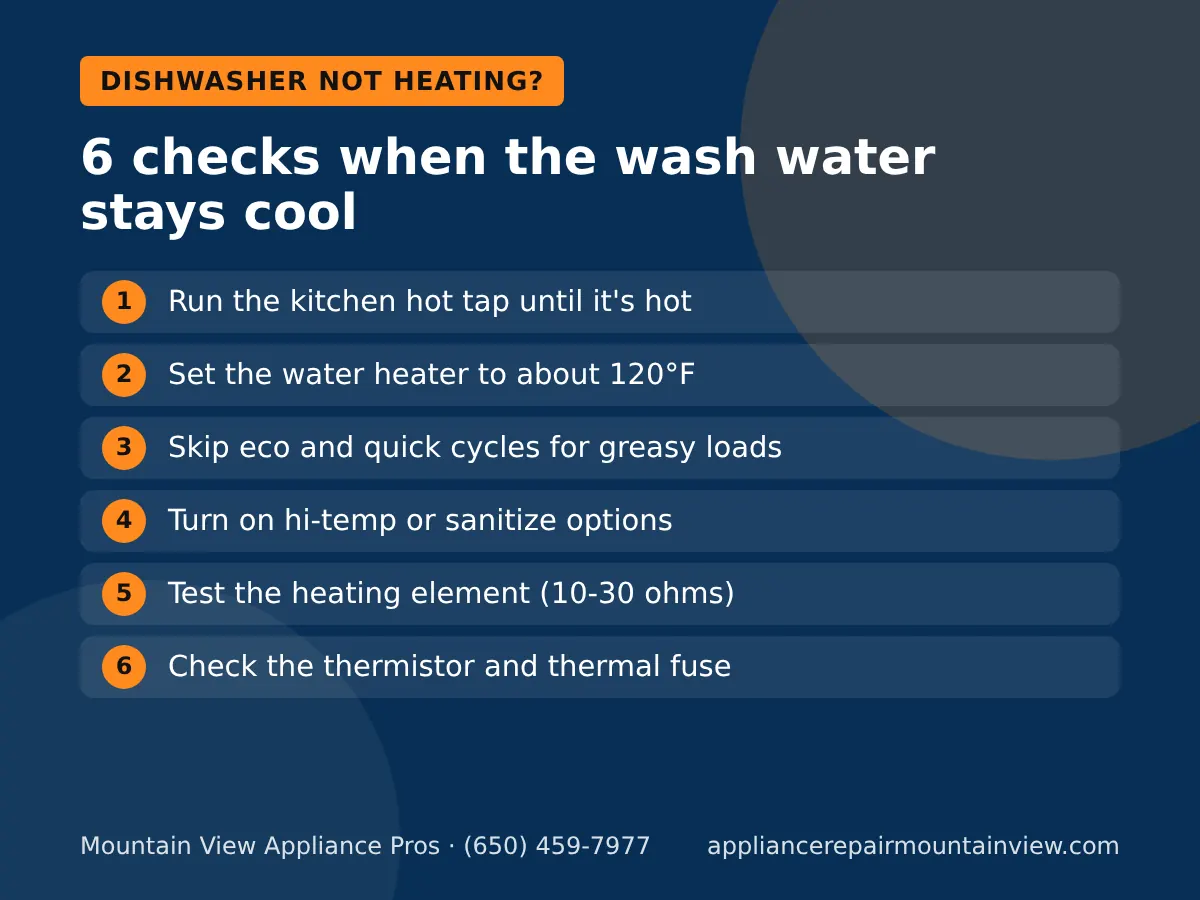
Wash water that never gets hot leaves grease, film and germs behind. Here is how to tell whether the problem is your hot water supply or the dishwasher itself.
Read the guidePowder caked in the drawer, softener left behind, or the whole cup still full? Here is why washers stop pulling detergent and what to check before you call.
Read the guide4C, 5C, UE, dC, LE, OE and more: what each Samsung washer code means, the quick checks you can do first, and when the part behind it needs a repair.
Read the guideCall now to talk to a real person, any time of day or night.
(650) 459-7977 Call Now – (650) 459-7977One call covers every major appliance in your home. Pick a service for signs, costs, and how the repair works.
Fridge warm, leaking, or noisy? We fix cooling, defrost, and sealed system problems.
See refrigerator repair →Washer won't drain, spin, or fill? We repair top-load and front-load machines.
See washer repair →No heat or no tumble? We fix gas and electric dryers and clear vent problems.
See dryer repair →Dirty dishes or standing water? We repair pumps, valves, and control boards.
See dishwasher repair →Oven not heating or heating unevenly? We repair wall ovens and ranges.
See oven repair →Burner won't light or element won't heat? We fix gas, electric, and induction.
See stove & cooktop repair →No ice, slow ice, or leaks? We repair built-in and freezer ice makers.
See ice maker repair →Not heating or dead display? We repair over-the-range and built-in units.
See microwave repair →