Oven Convection Fan Not Working? 6 Causes and What to Do
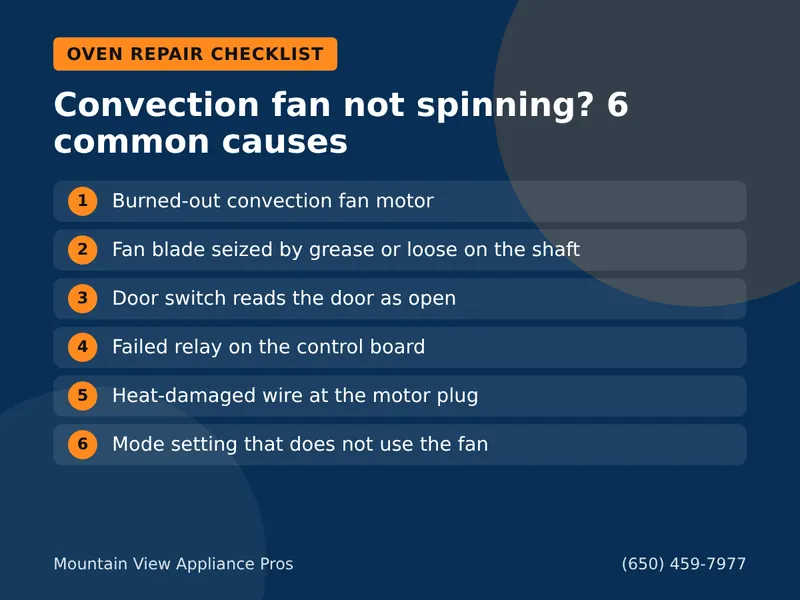
A convection fan that will not spin is usually a failed fan motor, a seized blade, a door switch or a relay on the control board. Here is how to narrow it down.
Read the guideCookies burnt on one side and pale on the other, or a roast that takes far too long, usually mean your oven is not heating the way it should. Here is how to find out why.
Call Now – (650) 459-7977
An oven that heats unevenly usually has a failing bake or broil element, a weak gas igniter, a faulty temperature sensor, a broken convection fan, or a worn door gasket. How you load the oven can also cause uneven results.
The first step is to find out what your oven is really doing. The dial or display shows the temperature you asked for, not always the temperature inside.
An oven that will not reach the set temperature usually has a failing bake element, a weak gas igniter, or a bad temperature sensor. On electric ovens, one dead element of the two (bake or broil) can let the oven warm but never reach 350°F. On gas ovens, a worn igniter opens the gas valve late or not at all, so the oven stalls well below the setting.
Put an oven thermometer on the center of the middle rack, set the oven to 350°F, and check it 20 minutes after preheat ends. Check it again a few times over the next half hour, since ovens cycle up and down.
The USDA explains how to use appliance thermometers. A small swing is normal. If your oven runs more than about 25°F hot or cold on average, something needs attention.
An oven that runs cold is also a food safety issue for meat and poultry. Use a food thermometer and the safe minimum internal temperatures chart until it is fixed.
On electric ovens, look at the element at the bottom while the oven heats. It should glow evenly. Dark spots, blisters, or a crack mean it is failing.
On gas ovens, the igniter must get very hot before the gas valve opens. A weak igniter glows but takes too long, so the oven heats slowly or unevenly.
The sensor is a thin probe at the back of the oven. If it reads wrong, the oven may overshoot or undershoot. A technician can test it with a meter.
Convection ovens use a fan to move hot air. If the fan stops or slows, you get hot and cold zones. Listen for the fan, or look for it not turning in convection mode.
If the rubber or mesh seal around the door is torn or flat, heat escapes. Food near the door cooks more slowly.
Element glowing in spots or igniter slow to light? Call us and a technician can test the part and quote the fix.
It can be. A gas oven that struggles to light or burns with a yellow flame should be checked. Never use a gas oven to heat your home.
The EPA's guide to preventing carbon monoxide poisoning recommends having gas ranges and ovens inspected by a trained professional. If your cooktop burners also give you trouble, see our guide on gas burners that won't light.
Call if your oven is more than about 25°F off after preheat, if an element is damaged, if a gas oven is slow to light, or if the convection fan has stopped. Our oven repair service covers wall ovens and ranges from Wolf, Thermador, Viking, GE, Bosch, and more. Our repair cost guide shows typical oven repair prices.
Place an oven thermometer in the center of the middle rack, set the oven to 350°F, and wait 20 minutes after preheat. A reading more than about 25°F off points to a sensor, element, or calibration problem.
A little, yes. Most ovens are slightly hotter at the back or top. Large differences, like food burning on one side every time, usually mean a failing element, fan, or igniter.
A weak igniter is the most common cause. It glows but does not get hot enough to open the gas valve quickly, so preheat takes much longer than normal.
Tell us what your appliance is doing. We will quote the visit on the phone and book the first open slot, often the same day.
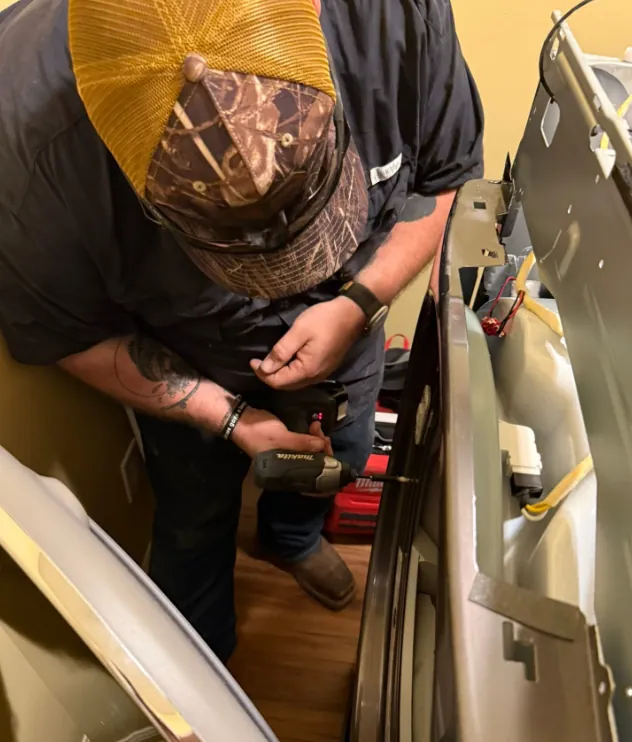
A convection fan that will not spin is usually a failed fan motor, a seized blade, a door switch or a relay on the control board. Here is how to narrow it down.
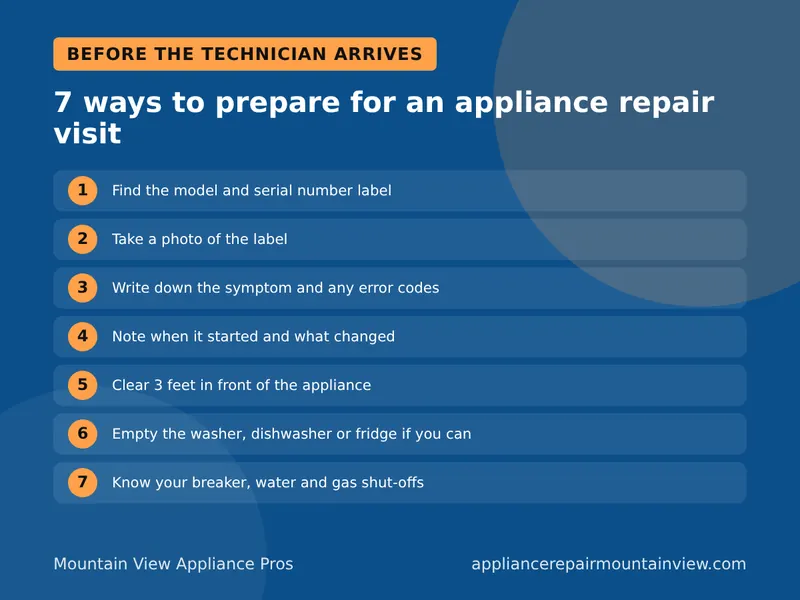
Read the guideA good repair visit starts with a diagnosis, a clear price and your OK before work begins. Here is what to have ready and what to ask so the repair goes fast.
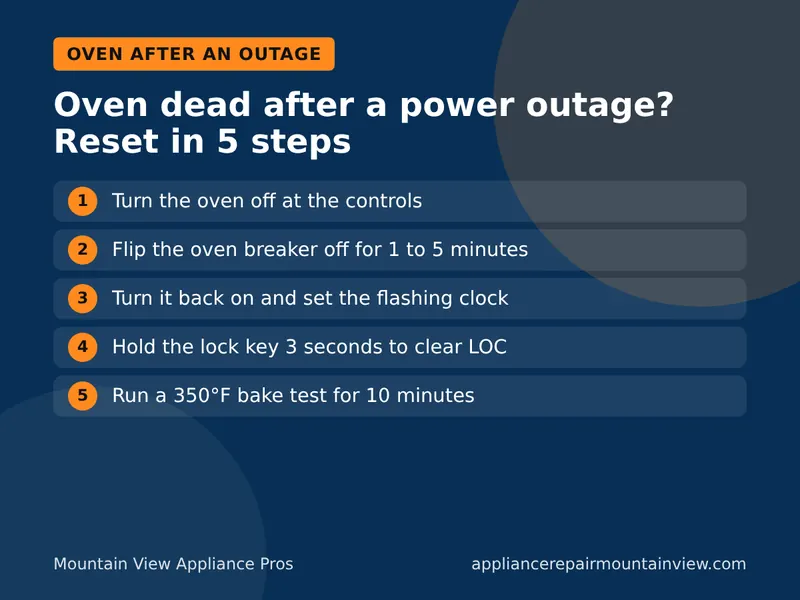
Read the guideMost ovens come back with a breaker reset and a clock set. If the display stays dark or the oven will not heat, a surge may have hit a fuse or board.
Read the guideCall now to talk to a real person, any time of day or night.
(650) 459-7977 Call Now – (650) 459-7977