What to Expect From an Appliance Repair Visit in Mountain View
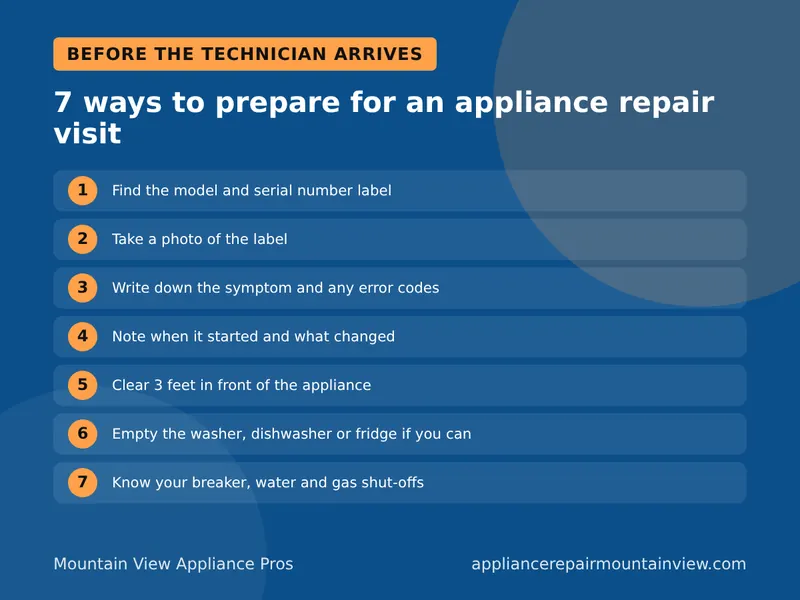
A good repair visit starts with a diagnosis, a clear price and your OK before work begins. Here is what to have ready and what to ask so the repair goes fast.
Read the guideYou pick convection bake, the oven heats, but the food cooks unevenly and you cannot hear the fan. Or the fan grinds, squeals or keeps running after you turn the oven off. A convection fan is a simple part, so the cause is usually easy to find.
Call Now – (650) 459-7977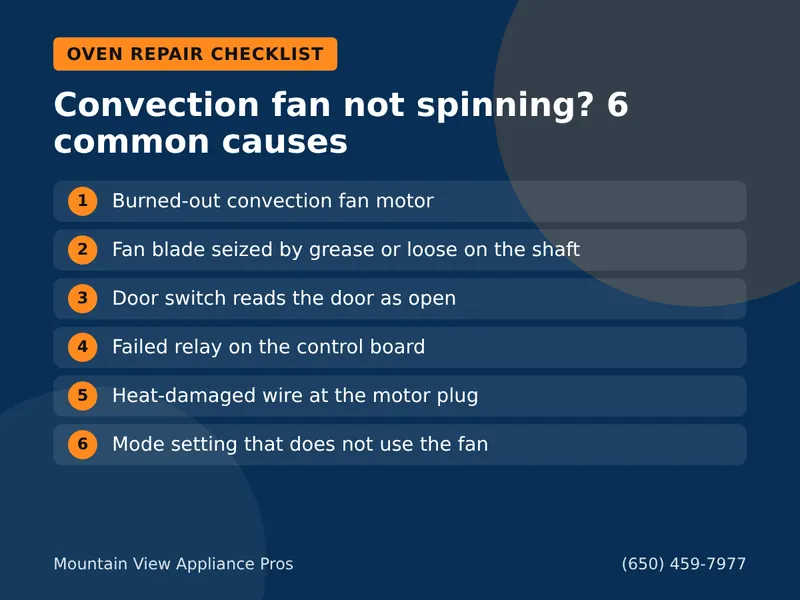
A convection fan usually stops for 6 reasons: the fan motor burned out, the blade seized or came loose, the door switch thinks the door is open, a relay on the control board failed, a wire near the motor broke from heat, or the convection setting is not on. A fan that spins but gives no heat points to the convection element instead.
If the checks below do not bring the fan back, our oven repair Mountain View CA technicians test fan motors, elements, door switches and boards on GE, Whirlpool, KitchenAid, Samsung, LG, Bosch, Thermador, Wolf and Miele ovens.
A true convection oven has two parts at the back: a fan and a ring-shaped heating element around it. The fan moves air. The element heats it. If you hear no fan at all, the problem is the fan side. If the fan spins but the oven heats slowly on convection only, the element or its fuse is the more likely part.
| What you notice | Most likely cause |
|---|---|
| No fan sound, bake works fine | Fan motor, wire or relay |
| Fan stops when the door opens, never restarts | Door switch |
| Grinding or scraping at the back | Blade loose or rubbing, worn motor bearing |
| Loud hum, blade does not move | Seized motor |
| Fan spins, convection bake stays cool | Convection element or its thermal fuse |
| Fan never stops, even with the door open | Stuck relay on the control board |
The motor sits behind the back wall of the oven, where it handles heat every time you bake. Over the years the windings fail or the bearings dry out. The fan hums, then stops for good. This is the most common repair.
Grease from roasting can build up on the blade and the shaft. A blade can also work loose and scrape the back panel. You hear grinding first, then the fan stalls.
Most ovens stop the convection fan when the door opens, so heat does not blow into your face. If the door switch fails, the oven acts as if the door is always open. The light may also stay on or off.
The control board sends power to the fan through a small relay. A relay can fail open, so the fan never starts, or stick closed, so the fan never stops.
The wires behind the oven get very hot, most of all after self-clean cycles. A wire can go brittle and break at the motor plug.
Some ovens only run the fan in true convection, not in "convection roast" or air fry. Others delay the fan for a few minutes during preheat. Check your manual for your mode before you book a visit.
Convection fan still dead? Call now for oven repair in Mountain View.
Do not take the back panel off a hot oven or one that still has power. The fan motor sits next to live wires and the convection element. If the fan does not start after these steps, the part needs testing with a meter.
A technician first checks for power at the fan motor while the oven runs convection. Power with no movement means a bad motor. No power means the problem is upstream, in the door switch, relay or wiring. Testing this way avoids buying parts you do not need, and most fan repairs are done in one visit.
In most cases, yes. Standard bake and broil do not use the convection fan. Cook with regular bake and use the normal recipe time. Stop using the oven if you smell burning plastic, see sparks, or if the fan runs nonstop with the oven off, because a stuck relay can keep other parts powered.
If the oven also will not heat or the display goes dark, read our guide on why is my oven not turning on. If baking is uneven even on regular bake, see our guide to an oven not heating evenly.
A convection fan repair is almost always worth it. Most oven repairs in Mountain View cost about $150 to $500 with parts and labor. A fan motor or door switch sits in the lower half of that range. A control board sits at the top. That is far below the cost of a new wall oven or a pro-style range from Wolf or Thermador, which many homes in Cuesta Park and Waverly Park have. On an oven older than about 15 years with a board that is no longer made, compare the quote with a new unit first.
Something else acting up? These guides may help: why is my oven not turning on, why does my dryer turn off after a few minutes and a refrigerator that is not cooling.
The most common causes are a failed fan motor, a blade that has seized or come loose, a door switch that stops the fan when it thinks the door is open, a bad relay on the control board, or a broken wire near the motor. The convection element can also fail while the fan still spins.
Yes. Regular bake and broil do not need the convection fan on most ovens. Use standard bake and add about 25°F, or the time the recipe gives for a regular oven, until the fan is fixed.
Many ovens run a cooling fan for 20 to 60 minutes after use, which is normal. If the convection fan itself keeps spinning with the door open or for hours, a relay on the control board may be stuck closed.
Most oven repairs in Mountain View cost about $150 to $500 with parts and labor. A convection fan motor is usually in the low to middle part of that range. A control board is at the upper end. You get the price before work starts.
Tell us what your appliance is doing. We will quote the visit on the phone and book the first open slot, often the same day.
A good repair visit starts with a diagnosis, a clear price and your OK before work begins. Here is what to have ready and what to ask so the repair goes fast.
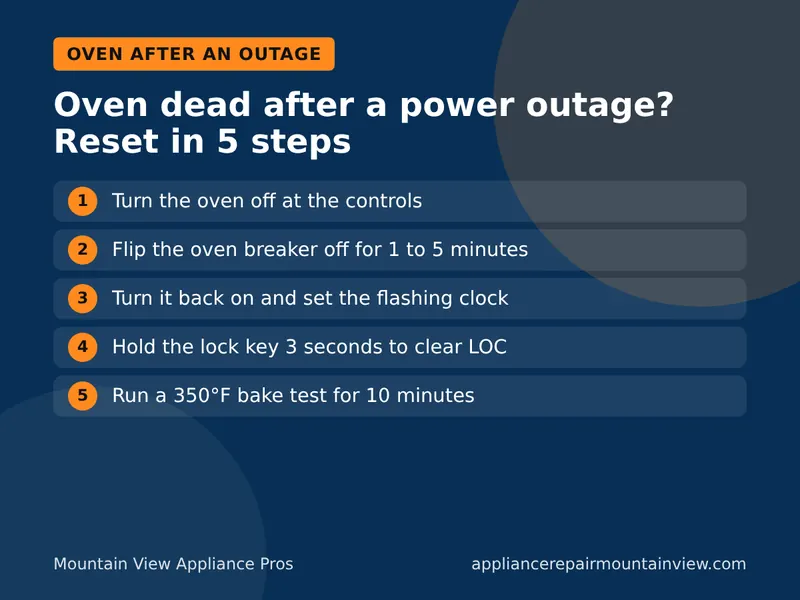
Read the guideMost ovens come back with a breaker reset and a clock set. If the display stays dark or the oven will not heat, a surge may have hit a fuse or board.
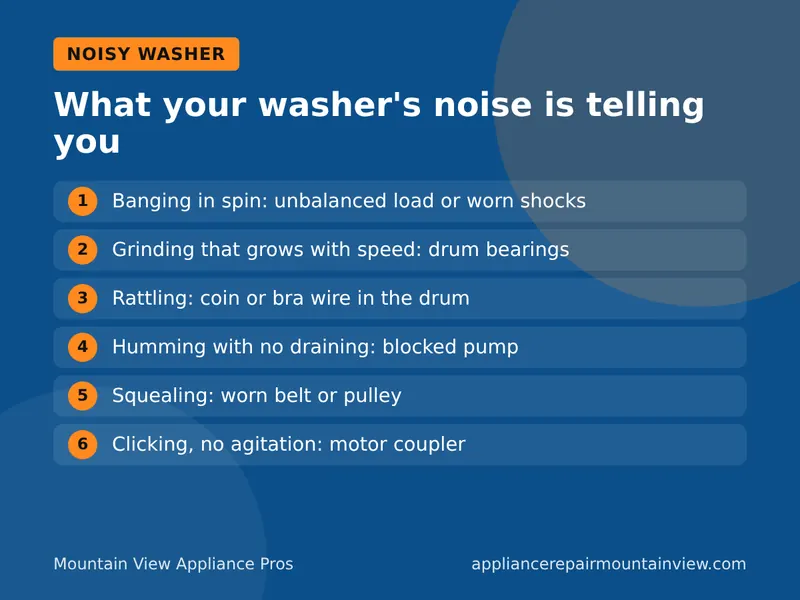
Read the guideBanging usually means an unbalanced load. Grinding during spin points to bearings. Humming with no draining points to the pump. Here is how to tell them apart.
Read the guideCall now to talk to a real person, any time of day or night.
(650) 459-7977 Call Now – (650) 459-7977