Dishwasher Not Heating Water: Causes, Checks and Repair Costs
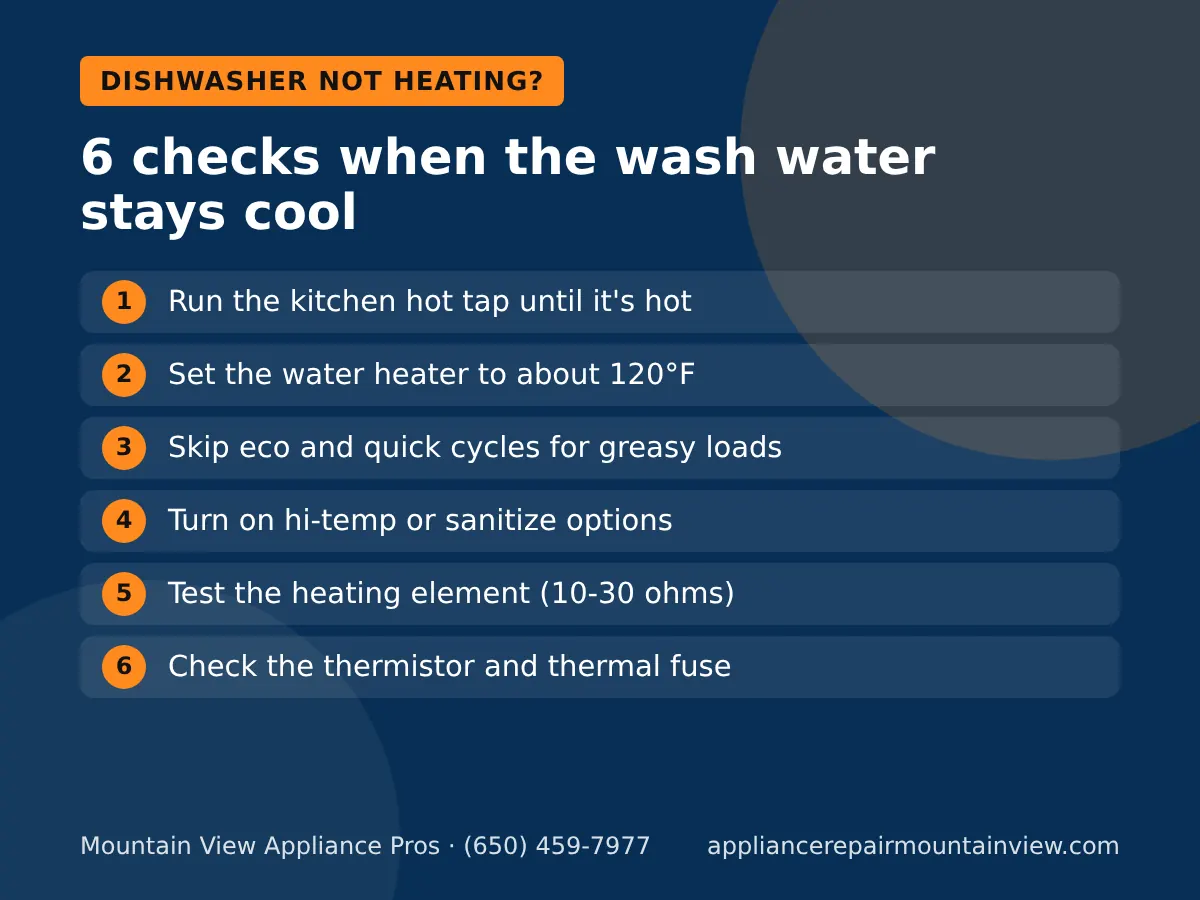
Wash water that never gets hot leaves grease, film and germs behind. Here is how to tell whether the problem is your hot water supply or the dishwasher itself.
Read the guideYour washer finishes with water still in the drum, or it drains so slowly the cycle times out. Before you blame the pump, look at the hose. A kink behind the machine, a sock stuck inside it, or a hose pushed too far into the standpipe causes a lot of drain problems we see in Mountain View. Here are six checks you can do in about 30 minutes.
Call Now – (650) 459-7977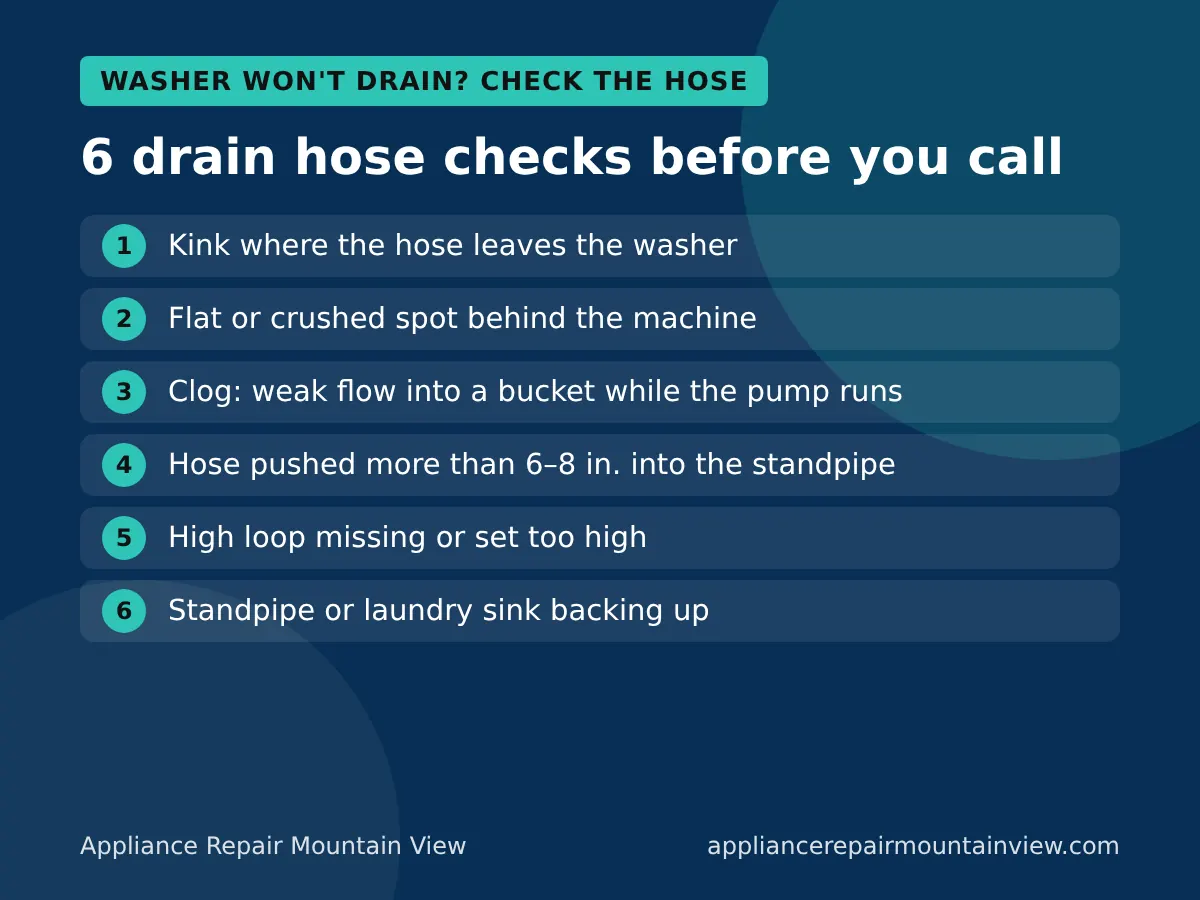
Yes. The drain pump pushes water up through the hose and into your standpipe or sink. A kink, a crushed section, a clog or a hose end shoved too far into the pipe all block or slow that flow. The washer then stops with water inside or shows a drain error, the same as it would with a failed pump.
The hose is the cheapest part of the drain system and the easiest to check. So it makes sense to rule it out first. If the hose checks out fine, our main guide on a washer that is not draining covers the pump, lid lock and control causes.
You'll need a bucket, old towels, a flashlight, pliers for the clamp and maybe a long flexible brush. Unplug the washer before you reach behind it.
Check for a kink behind the washer, a crushed or flattened section, a clog inside the hose, the hose depth in the standpipe, the height of the hose loop, and the drain the hose empties into. Work through them in that order. The first two take a minute, and most hose problems turn up in the first four checks.
| Check | What you look for | Quick fix |
|---|---|---|
| 1. Kink | Sharp bend where the hose leaves the washer or hits the wall | Pull the washer out 3 to 4 inches and reshape the curve |
| 2. Crushed spot | Flat or creased section, often from the machine walking during spin | Replace the hose if it stays flat |
| 3. Clog | Weak flow into a bucket while the pump runs | Flush or brush it out |
| 4. Too deep in the standpipe | More than about 6 to 8 inches of hose inside the pipe | Pull it up and secure it with a hose strap |
| 5. Loop height | No high loop, or the hose runs far above the pipe | Set the loop within your manual's range |
| 6. House drain | Water backs up out of the standpipe or sink | Clear the house drain or call a plumber |
Unplug the washer and slide it out a few inches. Follow the hose from the back of the machine to the standpipe with a flashlight. Look for sharp bends, flat sections and spots pinned between the washer and the wall. Corrugated hoses can hide a crease, so run your hand along the full length and feel for flat areas.
Kinks are common in Mountain View laundry closets. Many older homes in Monta Loma, Rex Manor and Cuesta Park have tight hall closets, and newer townhomes near the San Antonio and Whisman areas often have stacked laundry with very little space behind the machine. Pushing a washer back after cleaning is enough to fold the hose.
Take the hose end out of the standpipe and put it in a bucket on the floor. Run a drain or spin cycle. Strong flow means the hose is clear and the problem is downstream. A weak trickle while the pump hums means a clog in the hose or pump. Then disconnect the hose at the washer and flush it.
Hard water adds to clogs here. Mountain View gets most of its water from the Hetch Hetchy system, which is fairly soft. Even so, detergent buildup and lint still collect in the lowest part of the hose over the years.
Hose is clear but the washer still won't drain? Call for washer drain repair in Mountain View before water sits and smells.
Only a few inches. Most manuals say about 4 to 8 inches inside the standpipe, with the hose held in place by a strap or clip. A hose pushed too deep seals off air flow, which can cause siphoning, slow draining or overflow. A hose that is too loose can pop out during spin and flood the floor.
Two problems point to a hose that is too deep or too low:
Pull the hose up, keep a high loop, and secure it with a zip tie or the hose guide that came with the washer. Never tape the hose into the pipe so it seals tight.
If water bubbles out of the standpipe or the laundry sink fills up during the drain, the hose is fine and the house drain is the problem. Lint, soap and hair build up in the standpipe trap over time. A slow kitchen sink nearby or a gurgling toilet can mean a bigger clog further down the line.
A lint trap or mesh filter on the hose end helps. Empty it after every few loads so it doesn't become the clog.
If the hose is clear, has no kinks, sits at the right depth and the house drain takes water fast, the problem is inside the washer. A drain pump that hums but moves no water, a pump that makes no sound at all, or a drain error that returns after the filter is clean usually means a failed pump, a bad door lock or a control fault.
Most washer repairs in Mountain View cost about $150 to $450 with parts and labor. A drain pump or door lock is usually in that range. The diagnostic visit is about $95 to $150 and is often credited toward the repair. You get the price before any work starts.
| Repair | Approx. cost in Mountain View |
|---|---|
| Diagnostic visit | $95 – $150 |
| Drain hose replacement | Usually at the low end of $150 – $450 |
| Drain pump replacement | Within $150 – $450 |
| Door lock or lid switch | Within $150 – $450 |
Our team handles washer repair in Mountain View for LG, Samsung, Whirlpool, Maytag, GE, Bosch, Electrolux and Speed Queen. We cover ZIP codes 94040, 94041 and 94043, from Old Mountain View and Waverly Park to Shoreline West and North Bayshore.
Drying trouble after the wash? Learn why does my dryer turn off after a few minutes and what to check first. In the kitchen, see what to do when your oven not heating up all the way leaves food raw in the middle.
Signs include water left in the drum after the cycle, slow draining, a humming pump with little water moving, and a drain error code. Unhook the hose at the standpipe, lower the end into a bucket and run a drain or spin cycle. A weak trickle with the pump running points to a clog in the hose or pump.
Yes. A kink or crushed spot behind the washer can block most of the flow. It often happens after the machine was pushed back against the wall. Pull the washer out a few inches and straighten the hose so it has a gentle curve.
Most manufacturers want the top of the hose loop between about 30 and 96 inches above the floor, with the hose end only a few inches into the standpipe. Check your manual for the exact range. Too low can cause siphoning, and too high can strain the pump.
Unplug the washer, shut off the water, and drain what you can through the filter or a bucket. Disconnect the hose, then flush it with a garden hose or push a long flexible brush through it. Look for lint balls, socks, coins and hair, then reconnect it with a fresh clamp.
Most washer repairs in Mountain View cost about $150 to $450 with parts and labor. A drain pump or drain hose replacement is usually in that range. The diagnostic visit is about $95 to $150 and is often credited toward the repair.
That is usually siphoning. If the hose end sits too deep in the standpipe or the standpipe is too short, water can flow out by gravity while the washer fills. Pull the hose up so only a few inches are inside the pipe and keep a high loop.
Tell us what your appliance is doing. We will quote the visit on the phone and book the first open slot, often the same day.
Wash water that never gets hot leaves grease, film and germs behind. Here is how to tell whether the problem is your hot water supply or the dishwasher itself.
Read the guidePowder caked in the drawer, softener left behind, or the whole cup still full? Here is why washers stop pulling detergent and what to check before you call.
Read the guide4C, 5C, UE, dC, LE, OE and more: what each Samsung washer code means, the quick checks you can do first, and when the part behind it needs a repair.
Read the guideCall now to talk to a real person, any time of day or night.
(650) 459-7977 Call Now – (650) 459-7977One call covers every major appliance in your home. Pick a service for signs, costs, and how the repair works.
Fridge warm, leaking, or noisy? We fix cooling, defrost, and sealed system problems.
See refrigerator repair →Washer won't drain, spin, or fill? We repair top-load and front-load machines.
See washer repair →No heat or no tumble? We fix gas and electric dryers and clear vent problems.
See dryer repair →Dirty dishes or standing water? We repair pumps, valves, and control boards.
See dishwasher repair →Oven not heating or heating unevenly? We repair wall ovens and ranges.
See oven repair →Burner won't light or element won't heat? We fix gas, electric, and induction.
See stove & cooktop repair →No ice, slow ice, or leaks? We repair built-in and freezer ice makers.
See ice maker repair →Not heating or dead display? We repair over-the-range and built-in units.
See microwave repair →